A Portland mortgage broker chasing a slow closing usually doesn’t have a rates problem or a borrower-quality problem — they have a missing-document problem, widely cited as one of the leading causes of loan processing delays industry-wide. A custom GoHighLevel build tracks exactly which document is still outstanding, for which borrower, and sends specific, automatic reminders instead of a loan officer manually checking a checklist for every file on their desk.
In plain numbers: Incomplete documentation is widely cited as a leading cause of mortgage application delays (Visionet, 2026 mortgage document delay research). Missing pay stubs and employment verification gaps are commonly cited as early holdups before conditional approval. Most loans take roughly 30-60 days to close, and files with document issues can often run well past 60 days.
Here’s the pattern that plays out constantly: a borrower submits most of what’s needed, a loan officer assumes the file is complete, and it isn’t discovered that page 2 of a bank statement is missing until underwriting flags it days later — by which point the closing timeline has already slipped.
Why this matters especially in Portland
Portland is a design-conscious Pacific Northwest market, and that expectation for a smooth, modern experience extends to how borrowers expect the loan process to feel:
- Borrowers expect a clean, guided digital process. A market this design-conscious notices when document collection feels disorganized or repetitive — it reflects on the broker’s professionalism, not just the paperwork.
- A competitive brokerage and lending market. A broker who closes loans faster and with fewer surprises builds referral business faster than one whose files routinely stall on paperwork.
- Rate-sensitive refinance activity. When rate windows are narrow, a document delay can mean missing the window entirely — the cost of a stalled file is higher when timing matters this much.
Top
Widely cited cause of mortgage delays: incomplete documentation
30–60
Typical days from application to closing
60+
Days for files with document issues, often
| Item | Value |
|---|---|
| File with document issues (often exceeds) | 60 days |
| Clean file, upper end | 60 days |
| Clean file, lower end | 30 days |
Source: Visionet, 2026 mortgage document delay research; Amerisave, 2026 mortgage loan processing guide
These are broad mortgage-industry figures, not a Portland-specific study — treat the exact day counts as directional. The consistent finding: document completeness, not borrower creditworthiness, is the most common reason a closing timeline slips.
What a custom document-tracking build should do
What custom document tracking should handle
| What it tracks | What it enables | Why it matters |
|---|---|---|
| Specific outstanding documents per borrower | Precise reminders, not a general "send your documents" ask | Borrowers respond better to specific requests |
| Document freshness (e.g. outdated statements) | Flags a document that needs re-submission before underwriting catches it | Prevents a late-stage surprise that stalls the file |
| Per-loan-officer visibility | Shows which files are at risk of stalling, across the whole pipeline | Catches a slipping file before the closing date is at risk |
| Automatic reminder cadence | Follows up without a loan officer manually tracking timing | Nothing depends on someone remembering to check |
Manual checklist tracking vs. a custom build
Sends specific, automatic reminders
- Custom document tracking
- Manual checklist per file
Flags outdated documents before underwriting
- Custom document tracking
- Manual checklist per file
Scales cleanly as loan volume grows
- Custom document tracking
- Manual checklist per file
Relies on someone manually checking each file
- Custom document tracking
- Manual checklist per file
| Custom document tracking | Manual checklist per file | |
|---|---|---|
| Sends specific, automatic reminders | ||
| Flags outdated documents before underwriting | ||
| Scales cleanly as loan volume grows | ||
| Relies on someone manually checking each file |
What you actually get
- Fewer closings slip past their target date because a missing document was caught automatically, not discovered by underwriting.
- Borrowers get specific requests, not vague nagging — which means they actually respond faster.
- Your loan officers spend less time manually checking file status and more time on the parts of the process that need their judgment.
- You can see which files are actually at risk across your whole pipeline, not just the one someone happened to check today — the same visibility gap covered in our nurture automation guide for mortgage brokers.
Why document collection becomes the single biggest bottleneck in a mortgage file
It helps to look at why this keeps happening rather than just accepting it as a fact of the business. A mortgage file moves through several stages — application, processing, underwriting, conditional approval, clear-to-close, closing — and documentation gets touched at nearly every one of them. That repetition is where the bottleneck forms.
The back-and-forth email problem. A borrower is asked for “your last two pay stubs and most recent bank statement.” They send a pay stub and a partial screenshot of a bank app instead of a full statement. The loan officer notices three days later, sends a follow-up, the borrower is traveling and doesn’t reply for two more days, and a document request that should have taken an afternoon has eaten most of a week — without anyone acting in bad faith. Multiply that across a pipeline of twenty or thirty active files and it’s easy to see why “chasing paperwork” quietly becomes a loan officer’s biggest time sink.
Missing pages, not missing documents. The most common failure mode isn’t a borrower refusing to send something — it’s sending something incomplete. Page 2 of a bank statement with the summary totals, a W-2 with a corner cut off in a phone photo, a signature page without the preceding disclosure pages attached. These gaps are easy to miss on a quick read-through and are usually caught by underwriting, not by the person who first received the file — which means the delay surfaces at the worst possible point, late in the process, instead of early when it would have been a quick fix.
Documents go stale while they sit in a queue. Underwriting guidelines generally require income and asset documentation to reflect a recent window — a pay stub or bank statement that was current when submitted can fall outside that window simply because the file took a few extra weeks to move through processing. When that happens, the borrower has to be asked for the same document again, except now it looks to them like the broker lost the first one. Nothing was lost; the clock just ran out on it. A system that tracks submission dates against each document type’s freshness requirement is the only reliable way to catch this before underwriting does.
Rate-lock deadlines turn a documentation gap into a financial one. Rate locks typically run somewhere in the 30-to-45-day range. A pipeline-management failure — a document request that sits unanswered for several days, an appraisal that comes back late, a conditional-approval item that takes a week longer than expected to clear — can turn a comfortable lock window into a scramble with days left on the clock and no clear closing date in sight. At that point the options are all worse than the one that was available a week earlier: pay to extend the lock, accept the market rate if it’s moved against the borrower, or risk the deal falling apart. None of those outcomes trace back to the interest rate itself — they trace back to a documentation delay that compounded over the life of the file.
A communication-channel mismatch makes all of the above worse. Most loan officers default to email because it’s where the file lives and where attachments are easy to manage. Most borrowers, outside of work hours, are far more likely to notice and act on a text message than an email sitting in an inbox next to dozens of other unread messages. A reminder sent through the channel a borrower actually checks gets answered faster than the same reminder sent through the channel that’s merely convenient for the loan officer — which is why the strongest document-collection processes lean on SMS for the time-sensitive nudge and keep email for the detailed, itemized request and the actual file attachments.
Put together, these five failure points explain why document collection is so often the actual cause of a slow closing, even when everyone involved — broker, processor, borrower — is behaving reasonably. The problem isn’t effort; it’s that a manual, inbox-and-memory-based process has no reliable way to catch a stale document, a missing page, or a slipping deadline before it becomes visible as a stalled file.
How automated document-collection software should actually work, step by step
A document-tracking build that’s worth having does more than send reminders. Here’s the level of detail that separates a system that genuinely closes the gap from one that’s just a nicer-looking version of the same manual process:
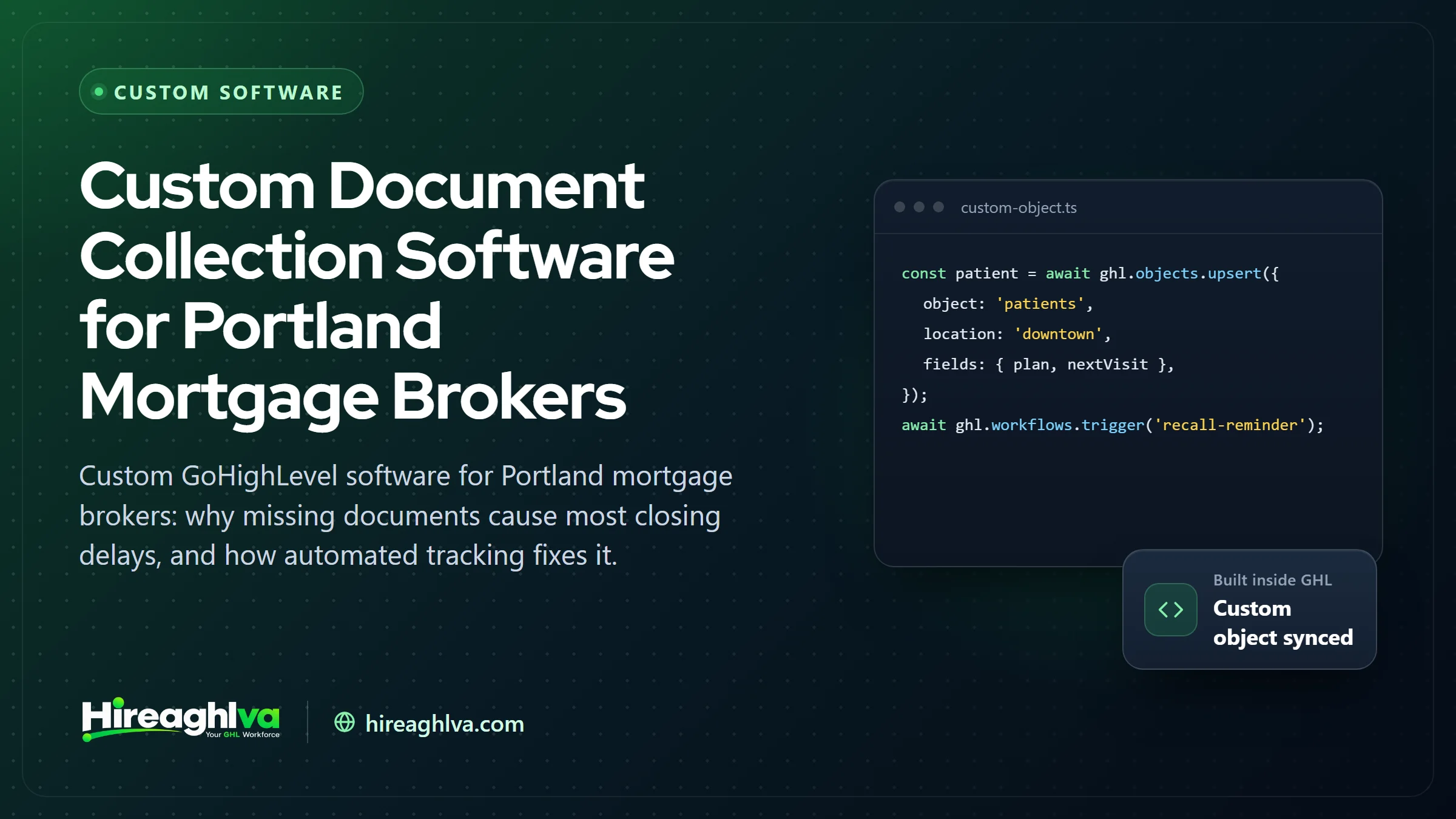
- Checklist generation by loan type, at intake. The moment a file is created, the system should generate the right checklist automatically based on loan type and borrower profile — conventional, FHA, VA, jumbo, self-employed-income cases each need a meaningfully different document set. This is what a custom object structure in GoHighLevel is for: fields that store exactly which documents a given borrower’s loan type requires, instead of a flat, one-size-fits-all list that over-asks some borrowers and under-asks others.
- One clear, itemized first request — not a vague list. Borrowers respond better to “we need page 2 of your March statement, showing your closing balance” than “please send your bank statements.” The initial ask should break the checklist into specific, named items so there’s no ambiguity about what’s acceptable.
- Secure upload tracking tied to each specific checklist item. Every document a borrower submits should map to a specific tracked field — not just a generic “file received” flag. That’s the only way the system (and the loan officer) can say precisely which items are done and which are still open, instead of having to re-open and re-read the whole file to figure that out.
- An escalating, automatic reminder cadence. Rather than one generic nag, a good cadence steps up in specificity and urgency: an early reminder naming exactly what’s outstanding, a follow-up a few days later if nothing’s moved, and — for files getting close to a deadline — a flagged task for the loan officer or processor to call rather than relying on another automated touch. The point isn’t more messages; it’s the right message at the right time.
- Missing-item and document-staleness flagging, before underwriting sees it. The system should check submission dates against each document type’s freshness requirement and automatically re-trigger a request when a previously-submitted document is about to age out — catching the problem while there’s still runway to fix it, not after underwriting kicks the file back.
- Pipeline-wide visibility for loan officers and processors. Instead of a loan officer mentally tracking “which files am I worried about,” a dashboard view should surface every file’s outstanding items, ranked by how close it is to its closing date or rate-lock expiration. This is the same kind of custom dashboard visibility that turns “I think that file is fine” into “I can see that file is fine.”
- A clean handoff once the packet is complete. When every checklist item is satisfied, the system should flag the file as document-complete and route it forward — to the processor, to the LOS, or to whatever the next manual step is — instead of that determination depending on someone re-checking the file by hand.
That level of granularity is what separates a real document-tracking build from a generic reminder sequence layered on top of a standard pipeline. It’s also why this tends to be a custom software build rather than something a stock snapshot handles out of the box — the per-loan-type logic and staleness tracking need custom fields and automation logic that go beyond a general-purpose template.
What to ask before you build or buy a document-collection system
| Question | Why it matters |
|---|---|
| How is data encrypted in transit and at rest, and who can access it? | You need a real answer, not a marketing line — and your own compliance officer should sign off on whether it satisfies your recordkeeping and privacy obligations, not the vendor. |
| Does it generate a different checklist per loan type, or one generic list? | A flat checklist either over-asks straightforward borrowers or under-asks complex ones — both slow things down. |
| Does it track document freshness, or just whether something was received? | A document can be "received" and still be stale by the time underwriting looks at it — freshness tracking is what catches that. |
| Does it integrate with your LOS and CRM, or become another silo? | A tracking system that doesn't talk to your system of record creates double entry and a second place for things to go out of sync. |
| Who can see pipeline-wide status, and can it be modified as guidelines change? | If visibility lives in one person's inbox, or the checklist logic is locked to a vendor's template, the system breaks the moment that person is out or a guideline changes. |
A buyer’s guide: evaluating a document-collection system
Beyond the specific questions above, a few broader things separate a build that holds up from one that looks good in a demo:
- Confirm compliance expectations internally first, not with the vendor. A vendor can tell you their platform is secure; only your own compliance officer can tell you whether a given setup meets your state licensing obligations and your firm’s recordkeeping policy. Treat that as a required internal sign-off step, not an assumption baked into the purchase decision.
- Ask what happens as loan guidelines change. Document requirements shift — a new disclosure form, a change in how a particular loan program verifies income. A system you can update yourself (or that your developer can update quickly) stays useful; one locked to a vendor’s fixed template starts falling behind the first time a requirement changes.
- Ask how it behaves at your actual volume, not a demo volume. A reminder cadence and dashboard that look clean with five sample files can get noisy or confusing at thirty active files. Ask for — or build toward — a view of how it performs at your real pipeline size.
- Separate “collects documents” from “tracks documents.” Plenty of tools collect files into a folder. Fewer track which specific checklist item each file satisfies, flag staleness, and surface what’s actually still missing. That distinction is the difference between a mild convenience and an actual fix for the bottleneck described above.
This is general operational guidance, not compliance or legal advice. Confirm any data-security, recordkeeping, or licensing question with your own compliance officer or counsel before relying on a vendor’s claims about what their system satisfies.
Common mistakes brokers make with document collection
- Using one checklist for every borrower. A self-employed borrower and a W-2 employee on a conventional loan need genuinely different document sets. Treating them the same either overwhelms simple files with irrelevant requests or under-collects from complex ones, both of which cause delay later.
- Sending general reminders instead of specific ones. “Please submit your outstanding documents” tells a borrower nothing actionable. “We still need page 2 of your March statement” gets a same-day response far more often.
- Getting the reminder cadence wrong in either direction. Too aggressive, and borrowers start ignoring messages from the brokerage entirely. Too passive, and a file quietly sits for a week before anyone follows up. The cadence needs to escalate — a light touch first, then a firmer one, then a human task — not repeat the same message on a timer.
- Not tracking document freshness. Treating “submitted” as the finish line, without checking whether a pay stub or statement will still be within its valid window by the time underwriting reviews it, is one of the most common and most avoidable causes of a late-stage surprise.
- No pipeline-wide view. When the only way to know a file’s document status is to open that file, something inevitably slips — usually the file nobody happened to check that week. A dashboard that surfaces risk across every open file closes that gap.
- Skipping LOS integration and creating a second system of record. A document tracker that doesn’t talk to the loan origination system becomes one more place data has to be manually re-entered, which adds exactly the kind of manual step the build was supposed to remove.
- Rushing the build without testing it against real loan files. A checklist-and-reminder system that hasn’t been run against a handful of actual files — with their messy real-world document types — tends to surface edge cases (an unusual income type, a trust document, a gift-letter scenario) only after it’s live, when fixing them costs more than catching them during testing would have.
The cost/ROI math: what a stalled file actually costs you
It’s worth being concrete about what’s actually at stake when a file stalls on documentation, because the cost isn’t just “a slower closing” — it compounds across several dimensions at once:
- Loan officer and processor time. Every hour spent re-chasing a document that was already technically “sent” — just incomplete, outdated, or misrouted — is an hour not spent on new applications or on borrowers who need actual judgment calls, not follow-up.
- Rate-lock risk. As covered above, a documentation delay that eats into a 30-to-45-day lock window can force a choice between an extension cost, a worse rate, or a dead deal. Any one of those outcomes is more expensive than the cost of catching the delay a week earlier would have been.
- Pipeline capacity. A broker whose loan officers are spending a meaningful share of their week manually tracking paperwork has a lower effective capacity than the headcount suggests — which caps growth at exactly the volume where hiring would otherwise make sense.
- Referral and reputation risk. In a market where brokers compete heavily on referrals — Portland’s brokerage and lending market among them — a borrower whose closing stalled on paperwork is a borrower who’s less likely to refer a friend, and more likely to leave a review mentioning exactly that.
Weighed against those costs, a document-tracking build is a comparatively small, one-time investment: a straightforward build is typically scoped and completed within a few weeks. A single avoided rate-lock extension fee, a single deal that doesn’t fall apart, or a handful of hours a week given back to loan officers across a full pipeline tends to cover that cost well inside the first few months — and the system keeps paying that back on every file afterward, not just once.
Oregon licensing, Portland’s market, and why the stakes are higher here
A few things about operating as a mortgage broker in the Portland area make reliable document collection more than a nice-to-have:
Oregon’s licensing structure adds its own paperwork discipline. Mortgage brokers, lenders, and loan originators operating in Oregon are licensed through the state’s Division of Financial Regulation, with applications and renewals processed through the Nationwide Multistate Licensing System (NMLS) — the same system used nationwide. That licensing comes with its own ongoing requirements: bonding, a trust-account arrangement for client funds held in-state, and continuing education for individually licensed loan originators. A brokerage that’s already managing that layer of regulatory recordkeeping has less tolerance for a second, borrower-facing paperwork process that runs on memory and inbox folders rather than a system that tracks what’s been collected and when.
Many Portland-area brokers operate across the Oregon–Washington border. Vancouver, Washington sits just across the Columbia River from Portland, and it’s common for a Portland-based broker to serve clients and originate loans in both states — which generally means holding a license in each state, under each state’s own regulator, with each state’s own document and disclosure requirements layered on top of the federal ones. That dual-state reality makes a consistent, system-enforced way of tracking exactly which documents a given file needs — rather than relying on a loan officer to remember which state’s rules apply to which borrower — more valuable than it would be for a broker operating in a single state.
Portland’s purchase-versus-refinance mix swings hard with rate cycles. When rates fall, refinance volume can spike quickly as homeowners move to act on a window that may not stay open long — and that spike often arrives faster than a brokerage can scale its processing capacity, which is exactly when a manual, person-dependent document process breaks down hardest. When rates are elevated and purchase activity dominates, Portland’s loans carry a second deadline on top of the rate lock: the contract’s own financing contingency date, which can be just as unforgiving as a lock expiration if paperwork stalls. Either way, the region’s sensitivity to rate-cycle swings means volume rarely arrives at a steady, predictable pace — which is precisely the condition under which an automated, consistent document process earns back the most time compared to a manual one.
It’s a design-conscious, referral-driven market. As noted earlier, Portland borrowers tend to notice when a process feels disorganized, and local brokers compete heavily on reputation and referral. A document-collection process that feels organized and specific — rather than like a generic, repeated nag — reflects directly on that reputation, in a market where it matters more than most.
How to tell if it’s actually working
A document-tracking build isn’t something you set up once and assume is paying off — it’s worth watching a small set of numbers to confirm it’s actually closing the gap it was built for:
- Days from application to document-complete. This is the single most useful number to track, separate from total days-to-close. It isolates exactly the piece of the timeline the build is meant to shrink, rather than mixing it in with appraisal delays, underwriting turnaround, or scheduling — variables the document system has no control over.
- Share of active files with at least one stale or missing item at any given time. If this number isn’t dropping over the first few months, either the checklist logic needs adjusting for a loan type it’s not handling well, or the reminder cadence isn’t reaching borrowers the way it should.
- Time from reminder sent to document received. A specific, itemized reminder should get a materially faster response than a generic one did under the old process. If response times aren’t improving, the reminders likely aren’t specific enough yet, or they’re arriving through the wrong channel for how that borrower actually checks messages.
- Number of files that hit underwriting with a missing or stale item underwriting catches first. This should trend toward zero. Every time underwriting — rather than the tracking system — is the one to catch a gap, that’s a flag the staleness logic missed something, and it’s worth reviewing why.
- Loan officer time spent manually checking file status. Harder to measure precisely, but worth asking loan officers directly a few months in: do they still feel like they need to open a file to know its status, or does the dashboard view actually answer that question for them now? If the answer is still “I have to check,” the visibility layer needs more work, not the reminder logic.
None of these need a dashboard of their own to start — a loan officer or ops lead can track the first two by hand for a month and already get a clear read on whether the build is doing its job. Once the pattern is established, that reporting can be folded into the same custom dashboard that shows pipeline-wide document status in the first place, so the team isn’t maintaining two separate views of the same problem.
It’s also worth revisiting the checklist logic itself every few months rather than treating it as finished. Loan programs change their documentation requirements, a lender you work with regularly might start requesting something new, and a checklist that was accurate at launch can quietly drift out of date in ways that only show up when a borrower gets asked for something that’s no longer actually required — or, worse, doesn’t get asked for something that now is.
Bringing it together
A mortgage broker’s biggest lever for faster, more reliable closings often isn’t rate speed or marketing — it’s making sure paperwork never becomes the silent reason a file stalls. Pair custom document tracking with a properly structured mortgage pipeline snapshot, an AI receptionist that answers every rate-shopper’s first call, automated follow-up that keeps every stage of the pipeline moving, and a fast mortgage broker website, and the whole process — from first inquiry to closed loan — runs with fewer surprises. If you’re weighing a custom build against a prebuilt snapshot, the deciding factor is usually volume and complexity: the more loan types and the more files in flight, the more a custom, per-loan-type tracking structure earns back its cost.
Written by the Hireaghlva GoHighLevel team
We build and run GoHighLevel accounts, automations, dashboards, and websites for agencies and local businesses across the US and Canada. This guide reflects that hands-on work, with sources cited inline where we reference outside data.