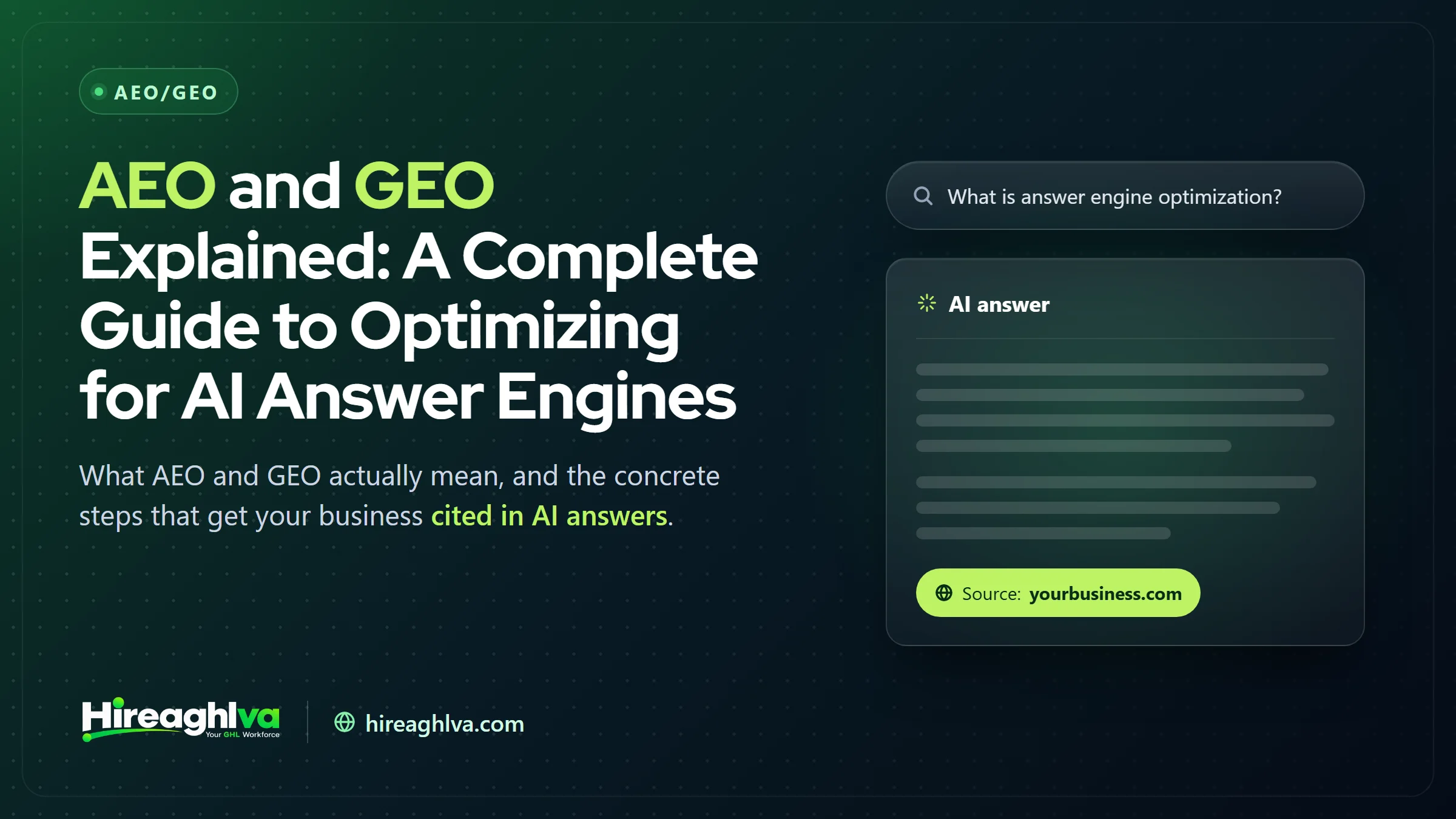
AEO (Answer Engine Optimization) and GEO (Generative Engine Optimization) are the practices of making your business the source AI systems like ChatGPT, Perplexity, Claude, and Google’s AI Overviews pull from and cite when they generate a direct answer. Search behavior is changing faster than most websites are adapting to it. A growing share of questions that used to become a Google search now happen inside those tools — and the way these systems decide what to reference is meaningfully different from classic ranking algorithms. This guide covers exactly what to actually do about it.
How are AEO and GEO different from traditional SEO?
AEO/GEO optimizes for being the source an AI system pulls from — or cites — when generating a direct, synthesized answer, while traditional SEO optimizes for a ranked list of blue links a human then clicks through. The end goal (be found, be trusted, get chosen) is the same; the mechanics of getting there shift in a few concrete, learnable ways — and the fundamentals in our local SEO playbook for service businesses still apply underneath.
Synthesis
AI answers synthesize multiple sources instead of ranking one link
Citation
Being cited/referenced matters as much as being clicked
Structure
Clear, structured content is easier for models to extract accurately
1. Structured, unambiguous content
AI systems parse content to extract facts, not to admire prose. Clear headings, direct answers positioned near the top of a section, and well-formed FAQ content (ideally backed by actual FAQPage schema) make it far easier for a model to lift an accurate, well-attributed answer from your page instead of paraphrasing a vaguer, less clearly structured competitor.
A practical test: read your own H2 sections in isolation, without the surrounding context. If a section’s first sentence doesn’t clearly answer what the heading promises, an AI system extracting from that section is likely to produce a vague or inaccurate summary of it too.
2. Structured data (schema.org) matters more, not less
Organization, Service, FAQPage, and LocalBusiness/service-area schema give AI crawlers explicit, machine-readable facts — your services, your pricing model, your service area — rather than requiring inference from prose alone. This is one of the most overlooked technical levers, and genuinely one of the easiest to implement correctly once you understand the relevant schema types for your content. For an industry-specific walkthrough, see how a Los Angeles med spa can get cited by ChatGPT and AI Overviews.
The four schema types that matter most for AEO/GEO
| Schema type | What it tells AI systems | Check |
|---|---|---|
| Organization | Who the business is | Name and details match your visible About/contact info |
| Service | What you offer and your pricing model | Services and prices match what the page displays |
| FAQPage | Direct questions and answers | Schema text matches the visible answers exactly |
| LocalBusiness / service area | Where you operate | Service area matches your location and service pages |
3. An llms.txt file
A newer, still-emerging convention: a plain-text file at /llms.txt that summarizes what your site/business is, written specifically for AI systems to parse quickly, alongside links to your key pages. It won’t replace good on-page content, but it gives AI crawlers a fast, structured summary to work from — and since it costs very little to implement, it’s a reasonable addition even while the convention is still gaining adoption.
4. Explicitly allowing AI crawlers
Some sites, often unintentionally, block AI crawlers (GPTBot, ClaudeBot, PerplexityBot, and similar) via robots.txt — sometimes as a side effect of a security plugin’s overly broad default settings. If you want to be discoverable through AI answer engines, your robots.txt needs to explicitly allow them, not just allow standard search crawlers and assume that’s sufficient.
GPTBot (OpenAI)
- Allowed
- Blocked (common default)
ClaudeBot (Anthropic)
- Allowed
- Blocked (common default)
PerplexityBot
- Allowed
- Blocked (common default)
Google-Extended
- Allowed
- Blocked (common default)
Eligible for AI citation
- Allowed
- Blocked (common default)
| Allowed | Blocked (common default) | |
|---|---|---|
| GPTBot (OpenAI) | ||
| ClaudeBot (Anthropic) | ||
| PerplexityBot | ||
| Google-Extended | ||
| Eligible for AI citation |
5. Genuine, specific expertise beats generic copy
AI systems, like search engines, are increasingly good at distinguishing thin, templated business copy from content that demonstrates real, specific expertise. Detailed process explanations, real pricing, and specific answers to specific questions perform better in both classic SEO and AEO/GEO contexts — because both are ultimately trying to reward the same underlying thing: content that’s genuinely useful to the person (or system) consuming it.
How do you know if AEO/GEO is working?
The most practical way to know if AEO/GEO is working is to periodically test a short list of relevant queries across ChatGPT, Perplexity, and Google’s AI Overviews and note whether your business is referenced.
Unlike traditional search, there’s no equivalent of Google Search Console yet for most AI platforms, which makes measurement genuinely harder. A practical approach: maintain a short list of queries relevant to your business and industry, and periodically test them across ChatGPT, Perplexity, and Google’s AI Overviews, noting whether and how your business is referenced. This won’t give you precise analytics, but it gives a reasonable directional signal over time.
Why this shift is happening now
For roughly two decades, the search experience was fundamentally stable: type a query, get a ranked list of links, click through to a page. AI-assisted search breaks that pattern in a specific way — instead of presenting a list and letting the user do the synthesis work, the system does the synthesis itself and presents a direct answer, often with citations to the sources it drew from.
This isn’t a niche behavior confined to dedicated AI chat tools anymore. Google’s AI Overviews now surface directly at the top of a meaningful share of traditional search results, meaning even users who never intentionally opened an AI tool are increasingly interacting with AI-synthesized answers by default. Combined with the continued growth of dedicated AI assistants as a genuine search starting point for a growing share of users — particularly for research-heavy or comparison-heavy queries — the practical reality is that a business’s visibility increasingly depends on being a source these systems trust and cite, not just a page that ranks.
How do AI systems decide what to cite?
Most AI answer systems decide what to cite through some combination of three steps: a retrieval step (finding relevant, indexed content related to the query), a ranking/relevance step (determining which retrieved sources are most trustworthy and relevant), and a synthesis step (generating a coherent answer, often with citations, from the selected sources). Understanding the mechanics, even at a simplified level, clarifies why the specific practices recommended in this guide matter.
The retrieval step depends heavily on your content being crawlable and indexed at all — hence the robots.txt and AI crawler access considerations covered above. The relevance/trust step draws on signals that overlap significantly with traditional SEO trust signals: structured data, clear authorship/organization information, content depth and specificity, and overall site credibility. The synthesis step is where clear, well-structured, directly-answering content has an advantage — a model synthesizing an answer from a page with a clear, direct answer near the relevant heading has an easier, more accurate extraction task than one working from a page full of vague, marketing-heavy prose that never quite states the actual answer plainly.
How AI answer engines choose sources, and what helps your content at each step
| Step | What the AI system does | What helps your content |
|---|---|---|
| Retrieval | Finds relevant, indexed content related to the query | Crawlable pages; robots.txt that allows AI crawlers |
| Ranking / relevance | Decides which retrieved sources are most trustworthy and relevant | Structured data, clear authorship/organization info, depth, specificity, site credibility |
| Synthesis | Generates an answer, often with citations, from the selected sources | Clear headings with a direct answer near the top of each section |
A practical content audit for AEO/GEO readiness
Rather than treating this as an abstract set of principles, here’s a concrete way to audit your own content:
Read each page’s H2/H3 headings in isolation, as a list. Do they read as clear questions or topics a person might actually search for? Vague, cute, or purely branded headings (“Our Approach,” “Why Us”) give an AI system far less to work with than direct, specific headings (“How Long Does GHL Automation Setup Take?”).
Check whether each section answers its heading within the first sentence or two. Content that builds up to an answer through several paragraphs of context before actually stating it is harder for both human skimmers and AI extraction to work with efficiently.
Verify your schema markup actually matches your visible content. Run your key pages through Google’s Rich Results Test or a similar schema validator, and manually confirm the marked-up data (prices, FAQs, service descriptions) matches what’s genuinely displayed on the page — mismatches here can actively hurt trust signals rather than helping them.
Confirm your robots.txt allows the major AI crawlers explicitly. Don’t assume a generic “Allow: /” covers this — many security plugins and hosting configurations add specific user-agent blocks that need to be checked and corrected individually.
The role of specificity over generic marketing language
One pattern shows up consistently across both traditional SEO and AEO/GEO performance: content written in specific, concrete terms consistently outperforms content written in vague, marketing-generic terms — and this gap appears to be widening as AI systems get better at distinguishing the two.
Compare two ways of describing the same service. Generic: “We provide comprehensive automation solutions tailored to your business needs.” Specific: “We build speed-to-lead automations that acknowledge a new lead within 60 seconds, route it to the right team member, and escalate if there’s no response within 15 minutes.” The second version gives both a human reader and an AI system something concrete and checkable to work with — actual numbers, actual mechanisms, actual outcomes — rather than a string of adjectives that could describe almost any business in almost any industry. (That second description is the kind of build covered in our speed-to-lead automation guide for GoHighLevel and delivered through our automation and workflow build-outs.)
A useful internal exercise: could a competitor’s marketing copy be swapped into your page with only the business name changed, and still sound plausible? If yes, that content isn’t specific enough to differentiate you to either a human reader or an AI system evaluating trust and relevance.
GEO-specific considerations beyond traditional AEO
While AEO and GEO overlap heavily, a few considerations lean more specifically toward generative engines and how they synthesize multi-source answers:
Consistency across your own content matters more. If different pages on your site state slightly different facts (different pricing, different process descriptions), a generative system synthesizing across multiple pages from your site may produce an inconsistent or confused answer — worse than if it had just used one clear, consistent source.
Third-party mentions and citations increasingly matter. Being referenced accurately by other credible sources (industry publications, directories, review platforms) appears to reinforce the trust signals AI systems use when deciding whether to cite you directly, similar to how backlinks function in traditional SEO but extended to any context where your business or claims are referenced online.
Freshness signals may carry more weight for certain query types. For rapidly evolving topics (pricing, current best practices, platform-specific features), content that’s clearly dated and periodically updated appears to be preferred over static content with no indication of when it was last verified — which is part of why we keep an “updated” date visible on content like this guide.
What NOT to do: common AEO/GEO mistakes
Keyword-stuffing FAQ sections with awkward, unnatural phrasing purely to match anticipated AI query patterns. This tends to read poorly to human visitors and doesn’t reliably improve extraction quality — natural, clear phrasing that happens to match how people actually ask questions works better than forced keyword density.
Publishing FAQPage schema that doesn’t match visible content, or duplicating the exact same FAQ schema across many pages without genuinely relevant, page-specific questions. This is both a poor practice for genuine AEO performance and a violation of the intent behind structured data markup.
Assuming AEO/GEO is a one-time setup rather than an ongoing practice. Content specificity, freshness, and structural clarity benefit from the same ongoing attention traditional SEO requires — a single optimization pass doesn’t create a permanent advantage as AI systems and their behaviors continue evolving.
Ignoring the traditional SEO fundamentals in favor of AEO-specific tactics. AEO/GEO layers on top of strong technical SEO; it doesn’t replace the need for it. A site with poor Core Web Vitals (see why Astro and WordPress differ so much on mobile performance), broken schema, or thin content won’t perform well in AI answer engines just because an llms.txt file was added.
Building an AEO/GEO-ready FAQ section, step by step
FAQ content is one of the highest-leverage, most learnable AEO/GEO practices, so it’s worth walking through how to build one properly rather than leaving it as a vague recommendation.
Start from real questions, not invented ones. The best source material is genuine questions your customers actually ask — during sales calls, in support tickets, in comments. Invented questions that nobody actually asks tend to produce generic, low-value answers even when they’re technically well-structured.
Write the answer to stand completely alone. A well-written FAQ answer doesn’t require the surrounding page context to make sense — it should read as a complete, accurate answer on its own, since that’s effectively how an AI system may extract and present it, stripped of its original page context.
Keep answers concise but genuinely complete. There’s a balance between brevity (easier to extract and cite cleanly) and completeness (actually answering the question fully). A good target is roughly 2–4 sentences that fully address the question without unnecessary padding or hedging.
Match the FAQPage schema exactly to the visible text. The schema markup should be a structured representation of exactly what’s shown on the page — not a summarized or reworded version, since any mismatch undermines the trust signal the schema is meant to provide.
Update FAQs as your actual answers change. A pricing FAQ with an outdated number, or a process FAQ describing a workflow you no longer follow, actively works against you — both misleading potential customers and creating exactly the kind of freshness/accuracy problem AI systems appear to weight when evaluating source trustworthiness.
A quick technical checklist you can action today
robots.txt
Explicitly allow GPTBot, ClaudeBot, PerplexityBot, Google-Extended
llms.txt
Add a plain-text summary of your business and key pages
Schema audit
Verify FAQPage/Service/Organization schema matches visible content
Heading audit
Rewrite vague headings as direct, specific questions/topics
| Item | Value |
|---|---|
| Steps to build an AEO-ready FAQ section | 5 |
| AI crawlers to allow in robots.txt | 4 |
| Key schema types to implement | 4 |
| Content audit checks | 4 |
| Common AEO/GEO mistakes to avoid | 4 |
Each of these is a concrete, scoped task rather than an open-ended strategic initiative — which is part of why AEO/GEO readiness, unlike some broader SEO work, can genuinely be tackled in a focused sprint rather than requiring months of sustained effort to see the foundational pieces in place.
Bringing it together
AEO and GEO aren’t a replacement for solid technical SEO — they’re an extension of it, with a handful of new, concrete additions: structured FAQ content, richer schema, an llms.txt file, and crawler-friendly robots.txt rules. Every website package we build includes these as standard, not as an upsell — because the shift toward AI-assisted search isn’t a future trend to plan for later. It’s already happening, and the businesses adapting to it now have a meaningful head start over the ones waiting to see how it plays out.
Written by the Hireaghlva GoHighLevel team
We build and run GoHighLevel accounts, automations, dashboards, and websites for agencies and local businesses across the US and Canada. This guide reflects that hands-on work, with sources cited inline where we reference outside data. Last reviewed September 13, 2026.